This article is also available in:
Deutsch: Kommissarin Malmström führt Zensur-Wettrüsten ein
Commissioner Malmström has been explaining to the European Parliament and to the press that her Internet blocking proposals are "only" about child abuse websites and "only" the kind of blocking that is in place in countries such as Sweden. At the same time, however, her officials have been convincing the EU's national home affairs ministries to agree in principle to measures to develop legal powers to destroy web resources outside the EU anywhere in an area covering the majority of the northern hemisphere.
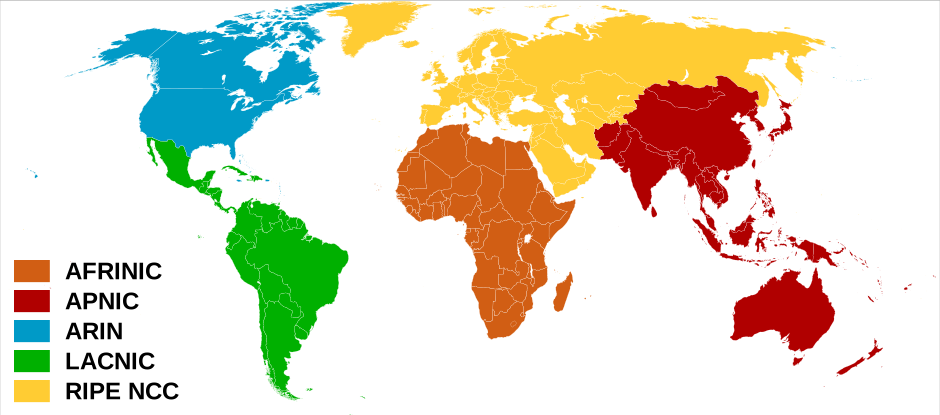
Buried in the Commission Communication on the Stockholm Programme adopted in June 2009 was a proposal to allow the EU to launch unilateral attacks on Internet resources in countries that rely on the RIPE NCC regional Internet registry in The Hague. Internet access or hosting providers considered to be involved in "criminal" activities (which would include alleged intellectual property infringements if the planned IPRED II Directive is adopted) anywhere in the RIPE area, which covers south-western, central and northern Asia as well as all of Europe, could be completely removed from the Internet under the measure.
After her own government rejected the proposal to include this policy in the Stockholm Programme, Malmström's services successfully pushed to have it included in the "Council conclusions concerning an Action Plan to implement the concerted strategy to combat cybercrime" adopted on 26 April. The text is very light on details at the moment, referring only to the adoption of "a common approach in the fight against cybercrime internationally, particularly in relation to the revocation of Domain Names and IP addresses".
The free speech dangers of countries giving themselves unilateral powers to destroy foreign web resources were very clearly illustrated in 2008. A British citizen living in Spain had been providing tourism services to Cuba for almost ten years. From one day to the next, all of his web resources disappeared. On further investigation it turned out that the United States had exploited the fact that he had registered his domain names through a US company to delete his entire web presence. While the EU's plans would allow this type of attack also, they go much further, as they would permit the destruction of entire ISPs, including all of their websites and all of their internet connections.
"I get very upset about being accused of censorship" - Commissioner Malmström in an interview with Europaportalen.
Interview with Cecilia Malmström (only in Swedish, 22.04.2010)
http://www.europaportalen.se/2010/04/malmstrom-om-censuranklagelserna-...
Interview with Cecilia Malmström (translated, 25.04.2010)
http://interfax.werebuild.eu/2010/04/25/censilia-interview-translated/
Commissioner Malmström's response to EDRi's open letter on blocking
(26.04.2010)
http://www.edri.org/files/malmstroem.pdf
A Wave of the Watch List, and Speech Disappears (4.03.2008)
http://www.nytimes.com/2008/03/04/us/04bar.html
Council conclusions concerning an Action Plan to implement the concerted
strategy to combat cybercrime (26.04.2010)
http://www.consilium.europa.eu/uedocs/cms_Data/docs/pressdata/en/jha/1...
Commission Communication on the Stockholm Programme
http://eur-lex.europa.eu/LexUriServ/LexUriServ.do?uri=COM:2009:0262:FI...
RIPE coverage map (yellow area)
http://upload.wikimedia.org/wikipedia/commons/9/95/Regional_Internet_R...
(Contribution by Joe McNamee - EDRi)
This article is also available in:
Deutsch: EuroDIG 2010: Wie geht es weiter?
Between the 29-30 April 2010, Madrid was the host of the third European Dialogue of Internet Governance (EuroDIG), an open platform for informal and inclusive discussion and exchange on public policy issues related to Internet Governance between stakeholders from all over Europe.
This year the event gathered more than 300 representatives from all domains: private and public sector, civil society or media. Other 60 Internet participants joined the event and interacted mainly through the 10 remote participation hubs organized in other European cities.
EuroDIG was the right place to debate a lot of major issues related to digital civil rights. This included a plenary on "Online content policies in Europe - where are we going?", where EDRi was represented by Meryem Marzouki that tackled the latest EU proposal of blocking child pornography website. All the participants agreed that deleting the illegal websites should be the logical main activity, with "a huge demand for improvements in international cooperation, particularly by creating efficient procedures and thus speeding up content takedown processes."
The presentations of the Russian journalist Andrei Soldatov and of the Avniye Tansug, editor of the Turkish edition of cyber-rights.org showed what levels of blocking can be reached if the door is open to the possibility of such a procedure. In Russia, the Internet Service providers are encouraged to block certain sites on their own initiative and in Turkey, there are now about 3700 websites officially blocked .
Another plenary was dedicated to the subject of "Global privacy standards for the internet and working world" where Andreas Krisch participated from EDRi's side. The solutions provided included the need for global privacy standards to enable the development of human rights friendly future technologies. And that privacy by design and by default needs to be the fundamental design principle for future technologies and applications.
The participants made reference to the importance of the data protection education, the Madrid Civil Society Declaration, the Council of Europe Convention 108 and the "Resolution of Madrid"- a Joint Proposal of International Standards on the Protection of Privacy.
The same problem - legal certainty through the adoption of global privacy standards - was raised from a slightly different perspective in the workshop on cloud computing by Katitza Rodriguez, International Rights Director from EDRi-member Electronic Frontier Foundation (EFF).
Increased education on data protection and Internet issues, not only to children but also to adults, was also the main key message of the EuroDIG local hub in Bucharest that debated the topics of "E-privacy and protection of children in the digital world". Comic books or videos produced at a national or international level were analysed to find the best solution for education purposes.
The EuroDIG debates are used to prepare the contributions of European stakeholders to the Internet Governance Forum to be held in Lithuania on 14-16 September 2010.
EuroDIG - reports and video (29-30.04.2010)
http://www.eurodig.org/
Remote participation to EuroDIG
http://www.eurodig.org/eurodig-2010/programme/information/remote-parti...
EuroDIG: Europe´s strong views on openness and responsibility(3.05.2010)
http://www.i-policy.org/2010/05/eurodig-europes-strong-views-on-openne...
EuroDIG participants prefer Delete instead Web Blocking (only in German,
30.04.2010)
http://www.heise.de/newsticker/meldung/EuroDIG-Teilnehmer-bevorzugen-L...
Debate on privacy in the digital environment (only in Romanian,
3.05.2010)
http://www.curierulnational.ro/Eveniment/2010-05-03/Dezbatere+pe+tema+...
This article is also available in:
Deutsch: EDRi und Partner veröffentlichen „Copyright for Creativity“-Dekla...
EDRi, as part of a broad based coalition of European groups, representing consumers, creators, libraries, civil society and technology companies today released Copyright for Creativity, a declaration calling for a European copyright law truly adapted to the Internet age. Copyright for Creativity calls for a copyright regime fostering digital creativity, innovation, education, and access to cultural works - and therefore ultimately European competitiveness in a digital world.
Copyright is based on both protection of creative works and exceptions to that protection, which allow for businesses and creators to innovate, make creative reuses of content, and to build on the work of others. For example, copyright protects a novelist's rights over her novel, while an exception recognising parody would allow another writer to create a new work of parody based on the original. While copyright protects an academic's published research, exceptions allow for others to cite, copy in-part, and quote from that research. A balance is therefore struck between the need to protect creators' rights, and the public benefit that can be realised through reuses, references, and other derivations of the work being created.
These exceptions are key to enabling legitimate reuses and innovation, and the activity of a number of socially and economically important stakeholders depends on them. While the public debate and political agenda around copyright focuses heavily on measures to protect ownership of creative works, the Copyright for Creativity declaration sets out a positive agenda by identifying a set of objectives that need to be achieved if copyright is to fully drive digital competitiveness, creativity and innovation.
Among its recommendations, the declaration calls for European copyright law to act as a spur to innovation, support education and research, facilitate digital preservation and archiving, and harmonise exceptions further across the EU. Also accompanying the declaration are clear examples of the shortcomings of the existing copyright regime; these examples illustrate the application of copyright exceptions in everyday life and their benefit to everyone.
Today's declaration is only a start, as the coalition expects many more signatories to join after the launch. Given that Members of the European Parliament already support the declaration, the coalition also expects it to serve as a basis for a much needed debate on copyright and the way to ensure that it best serves the interest of creators, innovators and users alike.
Full text of the Copyright for Creativity declaration
http://www.copyright4creativity.eu
This article is also available in:
Deutsch: Niederländische Urheberrechtsorganisation fordert Sperre von The Pira...
The Dutch copyright enforcement organisation Brein has requested Dutch internet provider Ziggo to block access to The Pirate Bay. The request concerns the blocking of access of Ziggo's subscribers to the website, which is hosted outside of The Netherlands. Ziggo has announced that it will not cooperate with the request, which means that Brein will likely request the court to order this.
If Ziggo were to be ordered to block access to a website, this would be a first in The Netherlands. EDRi-member Bits of Freedom reacted emphasizing that such an order would be at odds with the mere conduit-exception as set out in the E-commerce Directive and a threat to net neutrality.
The request to block the website comes after the Dutch court has decided that The Pirate Bay acts unlawfully vis-a-vis Dutch rightsholders, and ordered to deny Dutch users access to infringing torrents. The Pirate Bay has not complied with this order.
Brain asked Ziggo to block The Pirate Bay (only in Dutch, 29.04.2010)
http://www.nu.nl/internet/2237899/brein-vraagt-ziggo-blokkade-the-pira...
In the news: BRAIN Ziggo calls to block ThePirateBay (only in Dutch,
30.04.2010)
http://anti-piracy.nl/nieuws/bericht.asp?nieuwsberichtid=207
(Contribution by Ot van Daalen - EDRi-member Bits of Freedom - Netherlands)
This article is also available in:
Deutsch: Deutschland und Großbritannien stellen Datensammlung durch Google Str...
As Google's Street View service continue to be a controversial topic especially in Europe, Google has tried to clarify some issues about the data collected by means of its cars and the way it is used.
In February 2010, German officials threatened to take action against Google and, more recently, German data protection commissioner Peter Schaar was quoted to have stated he was "horrified" by the amount and type of data gathered by Google and demanded that the Wi-Fi database be deleted.
Germany's reaction drew the attention of the Information Commissioner Office (ICO), the UK's privacy watchdog. The ICO spokeswoman said British regulators were interested in how the data collected was processed and used by Google.
One of the main issues seems to be that Google is collecting Wi-Fi related data from people's routers as the cars drive on the streets taking photographs for Google Maps. Street View cars collect MAC (media access control) addresses and SSIDs (service set identifiers). The German officials consider that this type of data collection is illegal in Germany and ICO wants assurances and details related to this practice.
On 27 April 2010, Google's global privacy counsel Peter Fleischer explained in a blog post that Google's Street View cars were gathering information in three categories: photos of the street, WiFi network information, and 3D building imagery. In a letter also sent on 27 April to ICO and several other data protection agencies, Google wrote that it collected SSID and MAC information on routers that broadcast the names publicly and that information was accessible by anyone walking down the street with a WiFi-compatible device. The company insists that this type of information is public and that there are several other services that gather the same information, sometimes even for longer periods of time.
"This can be done without any intrusion into the privacy of a Wi-Fi network. (.....) We only use information that is publicly broadcast. It doesn't involve accessing the network to send or receive data," stated Fleischer.
The letter emphasized the fact that Goggle "never collects the content of any communications" from people's Wi-Fi transmissions. "In addition, the operator of the access point can choose to restrict the SSID from broadcast, and in many cases this will mean that the SSID is not received," says the letter.
Google goes transparent on Street View data collection (28.04.2010)
http://arstechnica.com/tech-policy/news/2010/04/google-talks-street-vi...
Data collected by Google cars (27.04.2010)
http://googlepolicyeurope.blogspot.com/2010/04/data-collected-by-googl...
UK data watchdog to quiz Google on Streetview Wi-Fi database (26.04.2010)
http://www.theregister.co.uk/2010/04/26/google_wifi_ico/
Google explains why Street View cars record Wi-Fi data (28.04.2010)
http://www.zdnet.co.uk/news/mobile-apps/2010/04/28/google-explains-why...
EDRi-gram: Article 29: Reduce the storing period of Google Street View's images
(10.03.2010)
http://www.edri.org/edrigram/number8.5/article-29-wp-google-street-vie...
This article is also available in:
Deutsch: EDPS drängt auf Überarbeitung der EU-Rahmenbedingungen für Datensch...
During his speech on 27 April 2010 at the European Privacy and Data Protection Commissioners' Conference in Prague, the European Data Protection Supervisor (EDPS) Peter Hustinx asked the European Commission to continue its efforts in updating the present legal framework for data protection.
Hustinx expressed the idea that in a society affected more and more by globalisation and technological development, there must be a legal context to avoid the increasing loss of relevance and effectiveness of data protection and therefore the European Commission should be ever more proactive in updating the relevant legal framework. "The stakes are not more and not less than how to ensure privacy and data protection in a highly developed Information Society of 2015, 2020 or beyond," said Hustinx.
The EDPS mentioned there had been progress lately in this direction. In the Spring Conference of European Data Protection Commissioners that took place in April 2009 in Edinburgh, discussions were started related to the evolution of the Data Protection Directive 95/46/EC and later on in May 2009, at the European Commission's conference in Brussels, a consultation was launched on the future of the present legal framework for data protection in the European Union and on how to respond to the challenges of technological change and globalisation. The Article 29 Working Party and the Working Party on Police and Justice, issued in December 2009 a substantial joint contribution to the public consultation. The main idea of the contribution is that although the main principles of data protection are still valid despite new technologies and globalisation, data protection in the EU needs a better application of these principles. EDRi has also submitted a response to the consultation recommanding the inclusion of stronger principles ensuring data minimisation and the clarification of the term "personal data".
While appreciating the steps forward made in the discussion of the issue, Hustinx believes the Commission must continue its efforts in this direction. "An ambitious approach is the only way in which we can ensure that our privacy and personal data are well protected, also in the future. It is essential that the Commission comes up with proposals that take into account what is really needed and does not settle for less ambitious results," said the EDPS.
In order to achieve an effective legal framework, Hustinx insisted on a few key conditions that the future directive must observe which include the integration in ICT of "privacy by design"(privacy and data protection compliance designed from the beginning into information systems and technologies and at all stages of their development) and "privacy by default"(parameters controlled by users). Another key element should be more accountability for controllers. "Accountability requires that controllers put in place internal mechanisms and control systems that ensure compliance and provide evidence - such as audit reports - to demonstrate compliance to external stakeholders, including supervisory authorities." This would bring "added value for an effective implementation of data protection in practice, over and above the mechanisms that are currently available in the Directive."
The Commission is to issue its conclusions and proposals on the issue by the end of this year with a possible review of the EU Data Protection Directive.
"The Strategic Context and the Role of Data Protection Authorities in the
Debate on the Future of Privacy" (29.04.2010)
http://www.edps.europa.eu/EDPSWEB/webdav/site/mySite/shared/Documents/...
EDPS Press Release - Reform of EU Data Protection law: EDPS calls on the
European Commission to be ambitious in its approach (29.04.2010)
http://www.edps.europa.eu/EDPSWEB/webdav/site/mySite/shared/Documents/...
The Future of Privacy - ARTICLE 29 Data Protection Working Party and Working
Party on Police and Justice Joint contribution to the Consultation of the
European Commission on the legal framework for the fundamental right to
protection of personal data (1.12.2009)
http://ec.europa.eu/justice_home/fsj/privacy/docs/wpdocs/2009/wp168_en...
EDRi-gram: EDRi position on data protection (13.01.2010)
http://www.edri.org/edrigram/number8.1/position-data-protection-review
This article is also available in:
Deutsch: Google Image Suche verletzt laut BGH keine Urheberrechte
On 29 April 2010, the German Federal Supreme Court ruled that Google's image search did not infringe copyright.
The ruling comes in a case filed by an artist because, at the introduction of her name, Google's search engine was displaying thumbnail images of her pictures taken from her own site.
Google's search engine has a function allowing the searching of images posted by third parties on the Internet. The images found are displayed as scaled down preview pictures (thumbnails) which have a smaller pixel size than the original images. The preview pictures also include a link to the websites which displays the original photos.
The Court decided that by showing these images, Google was not in breach of copyright because the artist had not used the simple technical measure allowing her to stop Google from indexing her site. Although the artist had not explicitly consented to the use of the images she, however, had not blocked her website from being indexed by search engines thus giving an implicit permission to any search engine to display the thumbnail images.
Site owners have the possibility to use commands in the website that can tell search engines not to index all or part of their site or files. Google has a crawling programme, Googlebot, that ignores the images disallowed by web users. This did not happen in this case because the artist did not make use of this tool.
The Court also said that when a person's images appear in Google searches as published on-line by third parties without the artist's permission, the company would be liable only if it was informed of the copyright infringement and did not act upon it. In agreement with the E-Commerce Directive, the service providers are not liable for the illegal acts of their users until they are notified about them.
This is a first case where Google wins in Germany as it had previously lost two other cases over the appearance of thumbnails of artists' works in its image search service. In the US, Google succeeded in winning a similar case under the provision of "transformative use" of the US copyright law. The provision says that a "transformative use" of a work is a fair use as it puts it under a different use than the original. "A search engine provides social benefit by incorporating an original work into a new work, namely, an electronic reference tool," said the ruling.
Google European Public Policy Blog commented: "We're heartened by the German Supreme Court´s ruling that Google Image Search doesn't infringe copyright. (...) Today´s ruling makes it clear not just for Google, its users in Germany and all owners of websites containing images, but also for all providers of image search services operating in the country: showing thumbnail images within search results is legitimate and millions of users in Germany benefit from being able to discover visual information at the click of a mouse."
BGH: Google's image search is no copyright infringement (29.04.2010)
http://ipkitten.blogspot.com/2010/04/bgh-googles-image-search-is-no.ht...
German Supreme Court rules that Image Search does not infringe copyright
(29.04.2010)
http://googlepolicyeurope.blogspot.com/2010/04/german-supreme-court-ru...
Google image search results do not infringe copyright, says German court
(30.04.2010)
http://www.out-law.com:80/page-10980
This article is also available in:
Deutsch: Aktionsplan für die Umsetzung des Stockholm-Programms
The European Commission published on 20 April 2010 its plan of actions for the implementation of the Stockholm Programme, the framework for EU actions on citizenship, justice, security, asylum and immigration policies for the period 2010-2014, which includes 170 initiatives.
In order to implement this complex programme, the Commission has identified a series of key action with clear timetables that should be taken during the 2010-2014 period, which include 10 concrete actions in the justice, fundamental rights and citizenship area.
Two concrete actions are proposed by the plan for personal data protection. First, the Data Protection Directive will be modernised in order to cope with the latest technological developments and to coherently integrate the existing data protection instruments for police and judicial cooperation in criminal matters. Also, "the same data protection principles should apply - no matter whether your data are processed for commercial or public enforcement principles (legislative proposal before the end of 2010)."
A second action of the Commission is to present by June a negotiation text for an "umbrella" data protection agreement between the EU and the US. This agreement must establish what "data can be shared with the US for law enforcement purposes exclusively (data for commercial purposes are not covered)." The agreement must clearly define the EU citizens' rights such as the possibility to file complaints about misused data.
In the negotiation with US for a long-term agreement on the processing and transfer of financial messaging data in the framework of the Terrorist Financing Tracking Programme (TFTP), the Commission will have in view significant data protection guarantees "such as a strict counter terrorism purpose limitation, an absolute prohibition on transfers on bulk data to third countries (only leads can be transferred). It aims at a potential limitation of the amount of personal data that is transferred to US authorities. The EU will have the right to terminate the Agreement in the event of breach of any of the data protection safeguards."
Other actions included in the plan are an evaluation report to be issued in 2010 on the application of the Data Retention Directive followed by a proposal for revision if necessary and a report on the implementation of the Decision on the interconnection of DNA, fingerprints and vehicle information databases.
Regarding cybercrime, the actions include the development of a legislative proposal on attacks against information systems, the creation of a cybercrime alert platform at the European level, the development of a European model agreement on public private partnerships in the fight against cybercrime and for cyber security and measures including legislative proposals to establish rules on the jurisdiction on cyberspace at the European and international levels. The plan also has in view the ratification of the 2001 Council of Europe Cybercrime Convention by the Member States.
The list of actions covers a legislative proposal on criminal measures aimed at ensuring the enforcement of intellectual property rights, probably the planned IPRED II Directive.
In terms of competencies the plan includes a recommendation to authorise EU accession to the European Convention on Human Rights. Also, the Fundamental Rights Agency Multiannual Framework should cover the domain of judicial and police cooperation in criminal matters.
Separately, the document lists the EU "Internal Security Strategy" which will represent another bundle of measures in the security areas. The Commission plan should be endorsed by the European Parliament and the Council and in agreement with the Lisbon Treaty, the Commission will work with the European Parliament, the Council and EU governments and parliaments for the adoption of the measures included in the plan.
European Commission plan to deliver justice, freedom and security to
citizens (2010 - 2014) (20.04.2010)
http://europa.eu/rapid/pressReleasesAction.do?reference=MEMO/10/139&am...
Stockholm Programme
http://www.se2009.eu/en/the_presidency/about_the_eu/justice_and_home_a...
This article is also available in:
Deutsch: Mitmachen!
La Quadrature du Net - ACTA: Signature collection for Written Declaration 12
continues
http://www.laquadrature.net/en/acta-signature-collection-for-wd12-cont...
4 May: Day Against DRM
http://www.defectivebydesign.org/
This article is also available in:
Deutsch: Lesestoff
Legal, Economic and Cultural Aspects of File Sharing
http://www.ivir.nl/publications/vaneijk/Communications&Strategies_...
http://arstechnica.com/tech-policy/news/2010/05/file-sharers-are-conte...
Data Protection and Cloud Computing under EU law
http://www.edps.europa.eu/EDPSWEB/webdav/site/mySite/shared/Documents/...
Boosting cultural heritage online: the European Commission sets up a
Reflection Group on digitisation
http://europa.eu/rapid/pressReleasesAction.do?reference=IP/10/456
This article is also available in:
Deutsch: Agenda
6-7 May 2010, Krems, Austria
4th International Conference on eDemocracy 2010
http://www.donau-uni.ac.at/en/department/gpa/telematik/veranstaltungen...
10 May 2010, Bruxelles, Belgium
Data Transfers in the New AFSJ: Go With The Flow?
Converging and Conflicting Ethical Values in the Internal/External
Security Continuum in Europe Workshop
http://www.ceps.eu/event/converging-and-conflicting-ethical-values-int...
22-24 May 2010 - Cologne, Germany
SIGINT 2010 - a conference for hackers, Internet residents and
activists, organized by Chaos Computer Club
http://events.ccc.de/sigint/2010/wiki/CFP
26-28 May 2010, Amsterdam, Netherlands
World Congress on Information Technology
http://www.wcit2010.com/
30-31 May 2010, Montreal, Canada
Third International Workshop on Global Internet Governance: An
Interdisciplinary Research Field in Construction
http://giga-net.org/page/2010-international-workshop
8-9 June 2010 - Funchal, Portugal
4th International Workshop on RFID Technology - Concepts, Applications,
Challenges - IWRT 2010
http://www.iceis.org/Workshops/iwrt/iwrt2010-cfp.htm.
25-27 June 2010, Cluj, Romania
Networking Democracy?
New Media Innovations in Participatory Politics
http://www.brisc.info/NetDem/
28-30 June 2010, Torino, Italy
COMMUNIA 2010 Conference: University and Cyberspace
Reshaping Knowledge Institutions for the Networked Age
http://www.universities-and-cyberspace.org
9-11 July 2010, Gdansk, Poland
Wikimedia 2010 - the 6th annual Wikimedia Conference
Call for participation by 20 May 2010
http://wikimania2010.wikimedia.org/wiki/Main_Page
25-31 July 2010, Meissen, Germany
European Summer School on Internet Governance
Call open until 15 May 2010.
http://www.euro-ssig.eu
29-31 July 2010, Freiburg, Germany
IADIS - International Conference ICT, Society and Human Beings 2010
http://www.ict-conf.org/
2-6 August 2010, Helsingborg, Sweden
Privacy and Identity Management for Life (PrimeLife/IFIP Summer School 2010)
http://www.cs.kau.se/IFIP-summerschool/
13-17 September 2010, Crete, Greece
Privacy and Security in the Future Internet
3rd Network and Information Security (NIS'10) Summer School
http://www.nis-summer-school.eu
14-16 September 2010, Vilnius, Lithuania
Internet Governance Forum 2010
http://igf2010.lt/
8-9 October 2010, Berlin, Germany
The 3rd Free Culture Research Conference
Submission of extended abstracts: 31 May 2010
http://wikis.fu-berlin.de/display/fcrc/Home
28-31 October 2010, Barcelona, Spain
oXcars and Free Culture Forum 2010, the biggest free culture event of all
time
3-5 November 2010, Barcelona, Spain
The Fifth International Conference on Legal, Security and Privacy Issues in
IT Law. Call for papers deadline: 10 September 2010
http://www.lspi.net/